
by Robert Haverly | Jun 26, 2020 | Blog, Erie PA, LASIK, News
Summertime often means long hours in the sun. Most of us remember to protect our skin by applying sunblock, but don’t forget that your eyes need protection as well. It is important to start wearing proper eye protection at an early age to shield your eyes from years of ultraviolet exposure. “UV radiation, whether from natural sunlight or indoor artificial rays, can damage the eye’s surface tissues as well as the cornea and lens,” says ophthalmologist Michael Kutryb, MD, a spokesperson for the American Academy of Ophthalmology. “Unfortunately, many people are unaware of the dangers UV light can pose. By wearing UV-blocking sunglasses, you can enjoy the summer safely while lowering your risk for potentially blinding eye diseases and tumors.”
Ultraviolet (UV) light can harm your eyes
Too much exposure to UV light raises your risk of eye diseases and other problems. Here are a few of the eye conditions you can avoid by wearing sunglasses:
- Cataracts and eye cancers can take years to develop. Each time you bask in the sun without eye protection, you increase your risk of serious disease. Babies and children need to wear hats and sunglasses for this very reason. People of all ages should take precautions whenever they are outdoors.
- Growths on the eye, such as pterygium, can show up in our teens or 20s. Surfers, skiers, fishermen, farmers and others who spend long hours under the midday sun or near rivers, oceans and mountains are at risk.
- Snow blindness, a form of photokeratitis, can quickly develop after exposure to UV reflections off of snow, ice, sand or water.
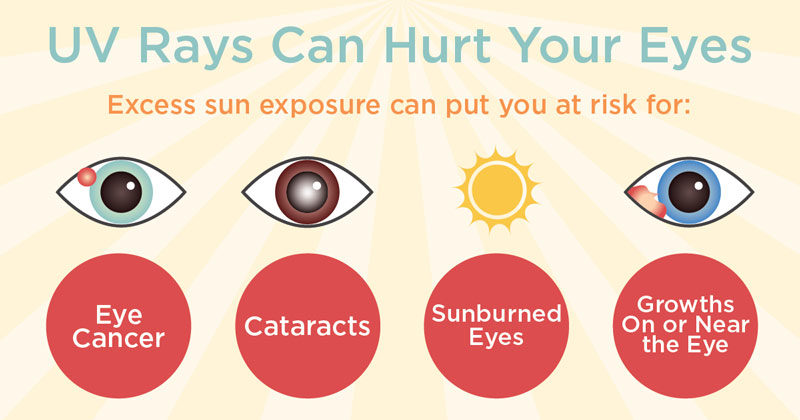
Exposure to UV rays raises the risk of eye cancers, cataracts, growths on the eyes, and sunburn to the eye
Protect your eyes from sun damage in every season
Many sunglasses shoppers forget to check the UV rating before purchasing a pair. Be sure to select sunglasses that provide 100% UV or UV400 protection, or block both UV-A and UV-B rays. If you’re unsure, check out our recommended types of sunglasses. Here are additional tips to protect your eyes from UV damage, no matter what the season:
By embracing these simple guidelines, you and your family can enjoy the sun safely all year long.
Sunlight and your health
Healthy exposure to sunlight can have positive effects, as long as you protect your eyes from UV damage. You need a little natural light every day to help you sleep well. That’s because the light-sensitive cells in our eyes play an important role in our body’s natural wake-sleep cycles. This is especially important as we age and become more apt to insomnia. Spending time outdoors in the daylight can also help prevent nearsightedness in kids. Not only is exercise great for eye health, but exercising outside may be additionally beneficial. Take your children outside to play to help lower their risk for nearsightedness and teach them good habits for a lifetime of eye health. Just don’t forget those hats and sunglasses! SOURCE: aao.org
by Robert Haverly | Jun 15, 2020 | Blog, Erie PA, LASIK, News
LASIK eye surgery is a form of laser eye surgery that can repair a person’s vision so that glasses and contacts are no longer needed. When performed by a qualified ophthalmologist, LASIK eye surgery can be of the utmost benefit to a person’s life. For now, let’s take a quick look at tips for preparing for laser eye surgery.
Go Through All Required Testing
Before signing up for laser eye surgery, it is important to make sure you are a qualified candidate. You will need to visit a licensed eye surgeon who specializes in laser surgery to ensure you are a good fit for LASIK. There are a variety of tests that have to be performed, including corneal thickness and corneal mapping. Prescription and vision testing also need to be performed to make sure you will benefit from laser eye surgery. *You can take the first step with us by scheduling your free consultation! Link below*
Don’t Wear Eye Makeup
For a few days before the surgery is to be performed, it is a good idea not to wear any eye makeup. In fact, the area around the eyes should be makeup free. If there is any makeup on your eyelashes during or after the surgery, this can increase the risk of infection. Wait awhile afterwards, too! A couple weeks is optimal.
Start Wearing Glasses
If you usually wear contacts, you will need to switch to glasses several days before your surgery, preferably at least a week in advance. If you wear hard contact lenses, they need to be removed at least four weeks before your surgery. The reason behind the importance of removing your contacts is that they shape your cornea when you wear them. Your cornea needs to be in its original shape when the surgery is performed.
You Need a Driver After Laser Eye Surgery
When getting laser eye surgery in Erie, you are going to need a trusted friend or family member to drive you to and from the appointment. It generally is not advised that you get behind the wheel of a car until your eyes are healed from the surgery, which is usually a day or two after the surgery has been performed.
Source: The Laser Center of Coral Gables
by Robert Haverly | Jul 2, 2019 | Blog
Author: Santo Rizzo
Nothing is better than warm weather, a good cookout, family and friends, and topping the night off with an extravagant firework show. July is not only for some 4th of July fun, but is also UV safety awareness month! UV, known as ultraviolet rays are released from the sun and are a form of radiation that is not only harmful to our skin, but very harmful to our eyes as well.
There are two main rays that are of concern from the sunlight and they are classified as UVA and UVB rays. UVB rays, featuring a short wavelength, can reach just the outer layer of our skin meanwhile UVAs, which feature longer wavelengths, can reach the middle layer of our skin. Not getting adequate protection from these type of sunlight rays can cause more issues than just sunburn. These issues include immune system suppression, premature aging, and skin cancer.
As mentioned above, overexposure to those ultraviolet rays can do quite a number to our eyes in the form of causing vision problems such as cataracts or macular degeneration and damaging parts of our eyes. In order to protect our eyes, we have a few options. Wearing a hat gives us the ability to not only protect our eyes, but it also prevents us from getting sunburnt on our heads. Additionally, wearing a wide-brimmed hat can reduce our eyes’ exposure to UV by up to 50 percent. We can couple wearing a hat with a good pair of sunglasses for the ultimate defense against those damaging sunrays. Polarized or non-polarized sunglasses are beneficial to protecting our eyes, but not all of them block 100 percent of UV rays so work with an optician to get the best possible pair. All sunglasses here at Laser Eye Surgery of Erie are polarized and offer 100 percent UV protection. It is important to note that our eyes need protection even on cloudy days because the sun’s harmful ultraviolet rays can penetrate cloud cover.
In addition to UV safety awareness, July is dry eye awareness month as well! Dry eye affects millions of people in the United States and it is often underdiagnosed. Dry eye disease is the result of a deficiency of one or more layers of tear film and there are many different factors that contribute to it. Some of those factors include, but aren’t limited to, our normal aging process, allergies, some medications, and exposure to environmental irritants. Spending too much time looking at a screen, such as a TV screen or a computer screen, also contributes to dry eye because our blink rate significantly decreases when we are focused on viewing something.
It is likely that dry eye is underdiagnosed because we don’t know the symptoms. These symptoms include frequent watery eyes, eye redness, increased light sensitivity, and tired eyes. If left untreated, dry eye can damage the surface of the eye and could potentially lead to vision loss. There are a few ways to treat dry eye, which include over the counter drops and prescription medications. The first line of treatment is lubricant drops, known as artificial tears, and they work best when they are used consistently. Lastly, it is best to consult your eye care provider if you are not getting ample relief from using artificial tears four times per day.
July Is UV Safety Awareness Month
https://www.allaboutvision.com/sunglasses/spf.htm

by Robert Haverly | Jun 5, 2019 | News
Author: Santo Rizzo
As we age, the likelihood of developing cataracts in our eyes increases. For those not familiar with the term, a cataract is the clouding of the lens in our eye that affects vision. Cataracts are not contagious and cannot spread from one eye to the other, so it is possible to only have a cataract in one eye. Most cataracts are age-related; however, we can start developing them as early as 40 years of age. Furthermore, during our 40s and 50s, most cataracts are too insignificant to cause any pressing issues to our vision, but it is likely that they will start to adversely affect our vision when we reach our 60s and by the age of 80, more than half of all Americans either have a cataract or have undergone cataract surgery.
Aside from age; diabetes, excessive drinking or smoking, and extended exposure to harmful ultraviolet sunlight are all other contributing risk factors. In our eyes, we have what is called a lens and it is a clear part of our eye, made up of mostly water and protein, that allows the eyes to focus light or an image on the retina. Cataracts form when protein from the lens clumps up and clouds a small area of the lens. With it being cloudy, our vision becomes blurry because for our retina to receive a sharp image, the lens needs to be fully clear. Over time, the larger the cataract grows, the more it clouds up the lens, thus making it gradually more difficult for us to see.
We might wonder how we can tell if cataracts are forming in our eyes. Symptoms include blurred vision, poor nighttime vision, and colors might appear to be a little faded. Struggling with glare from oncoming car headlights, lighting from lamps around our house, or just sunlight in general is also a symptom of a cataract. However, these symptoms can also be alerting factors to other eye issues as well, so if any arise contact your eye doctor. Treatment steps of early cataract development might include a new pair of eyeglasses, glare reducing sunglasses, or magnifying lenses. The only effective treatment if all else fails is cataract surgery, which involves the removal of the clouded lens in your eye (s), followed by the insertion of an artificial lens. There are some cases where the cataract must be removed even if it does not cause problems to our vision, but it often only needs to be removed if we experience vision loss in everyday activities such as driving, reading, or watching TV. Lastly, if you are wondering about how effective cataract surgery is before you even begin to ask questions to your eye doctor; that magic number is 90. In cases for the surgery, 90 percent of the time people have had improved vision afterwards.
https://nei.nih.gov/health/cataract/cataract_facts
Cataract Surgery

by Robert Haverly | Mar 11, 2019 | News
Millennials may have grown up in the digital age but wearing contact lenses and glasses can be a bit of a hassle. Laser eye surgery can make it easier for them to see clearly now and for years to come.
If you’re a millennial who is ready to get rid of contacts and glasses and see the world clearly, here are the top five reasons you should consider LASIK.
LASIK is a Cost-Effective Investment
Cost is a common concern for many millennials. However, correcting your vision with LASIK is a cost-effective solution, especially when you compare it to the cost of contact lenses and glasses.
Contacts and glasses can cost around $1,000 per year, which means you could spend up to $10,000 in ten years on just frames and lenses. With LASIK, you’ll only have a one-time payment for the procedure to permanently correct your vision.
At Laser Eye Surgery of Erie, we offer 0% interest financing for up to 24 months. You can also use your Health Savings Account (HSA) or Flexible Spending Account (FSA) to pay for LASIK. Plus, the cost covers post-operative appointments needed following your procedure.
LASIK Can Give You Longer-Lasting Clear Vision
As a millennial, you are old enough to undergo surgery. Typically, the minimum age requirement for LASIK is 18 years old. However, you also want to make sure you’re in good eye health and that your vision hasn’t changed in at least the past two years to qualify for the procedure. The sooner you undergo LASIK eye surgery, the less time you’ll spend wishing you got it done years ago!
Recovery Time is Quick
Recovery is an important part of any procedure. However, you won’t need to take too much time off from your life when you get LASIK. Generally, the surgery takes about ten minutes for each eye and six weeks for them to stabilize. During that time, you’ll need to rest your eyes and go to your post-op appointments to make sure everything is healing properly.
While it does take around six weeks for your eyes to heal, many patients see improvements in vision as early as the next morning. You should also be able to go back to work and resume normal activities the next day.
LASIK Eliminates Discomfort from Contacts
If you’ve worn contacts at all growing up, you know how uncomfortable they can be. From dry eyes to eye strain to infections, wearing contact lenses causes serious discomfort and even eye health issues for many millennials.
To make your life more comfortable, the best thing to consider is having your vision permanently corrected. As a millennial, you have years of life to look forward to; you want to make sure you experience and see everything comfortably. With LASIK, you eliminate the need for contacts and the issues that can come from them.
You Experience a Better Quality of Life
Millennials lead a fast-paced lifestyle. Whether you’re traveling the world or working hard to establish your career, life gets busy, and dealing with contacts and glasses can be cumbersome. Luckily, LASIK can help you get rid of them for good.
Imagine traveling without having to remember to pack extra contact solution, or being able to see your computer monitor and smartphone without your glasses. Imagine never having to worry about accidentally falling asleep with your contacts in!
Getting rid of your contacts and glasses and getting LASIK can make life easier. More importantly, it’ll help you experience the world clearly through your own eyes.
If you’re a millennial who is tired of dealing with contact lenses and glasses, it’s time to start considering LASIK as a vision correction solution. Not only can this quick and easy procedure give you the clear eyesight you need, but it’ll also help you save a bit of money in the long run and improve your overall quality of life.
Learn more about LASIK and schedule a LASIK consultation at Laser Eye Surgery of Erie today!

